A year ago, the AI conversation in many companies was about usage: how many licences or agents had been rolled out, how many employees already used an assistant, how many tokens were consumed each month. Today, in many of those same companies, it is about spending caps. They look like opposite strategies, but they share the same problem: both look at what goes in and neither measures what comes out.
There are three ways to think about the economics of AI. The first looks at spend, what we pay. The second looks at cost per outcome, what each resolved task costs us. The third looks at capacity, what the organisation can do now that it could not do before.
Spend: where every conversation starts
Spend is the first number people look at because it is the one on the invoice: tokens, licences, API calls, infrastructure. It has to be measured, because without those figures there is no financial discipline. And it is moving fast in two directions at once:
- On one side, the price of AI is falling faster than any other technology has: according to Epoch AI, the cost of a given level of performance (the price per million tokens, for example) drops 47% every quarter, so six months later the same work costs a quarter of the price.
- On the other, agents consume far more compute than the chat assistants the first budgets were built around, and Gartner expects the cost per agentic workflow to grow more than fivefold through 2028.
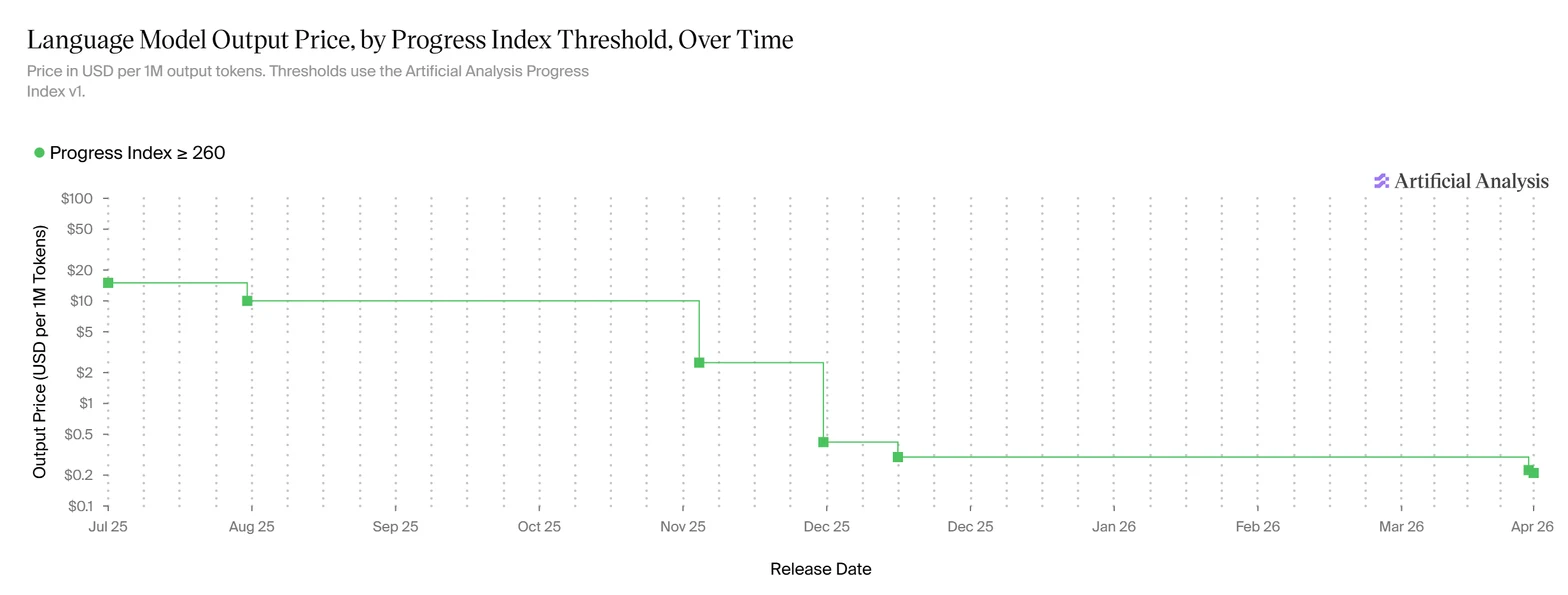
Neither figure says anything about value. A business case that calculates savings with today's price falls short within months, and a spending cap that ignores what each project produces cuts the best one as hard as the worst.
Cost per outcome: what each file costs
The second way of measuring changes the question, from what AI costs to what the outcome costs. How much does it cost to review the documents for a mortgage? To settle a claim, or validate a grant application? This is good old unit economics, and it is where AI spend is finally compared with something: the cost of a file before and after.
In our processes, the cost per resolved task usually ends up 40-50% below a manual process or a traditional BPO, with AI resolving 90-95% and the human team completing the rest. Models keep getting more efficient, which lets us cut costs and improve quality, and what remains is human review, whose costs rise roughly in line with inflation. For an operations director, the figure that matters is the cost of a file closed at the agreed quality; tokens are just one component of that cost. Even so, many of our clients find it hard to estimate their current cost per task and compare it with the cost of automating it, so wherever we can, we help them allocate those direct and indirect costs to build the business case.
The ceiling of cost per task
Cost per outcome has a ceiling too. The process stays the same, with the same queues and the same deadlines, and the only thing that falls is what each step costs. The back office is still sized for average volume, which is what it was designed for when people did everything, and that shows the day volume stops being average.
Capacity: how much volume you can absorb
In many cases, this is where the real competitive advantage lies. Picture a bank launching a mortgage campaign on TV. How many applications can it absorb the day after the ad airs, and how many campaigns can it run each year without operations holding marketing back? If you depend on human teams or a low level of automation, all you can do is make the best forecast possible. If you fall short, an overloaded BPO hurts the business; if you overshoot, you pay for a lot of people sitting idle.
Let's use round numbers. In a normal week, 400 applications come in every day and the team resolves 500. The campaign triples the intake for ten working days. With the usual process, the backlog reaches 7,000 files, response time goes from one day to fifteen, and clearing the backlog takes another three and a half months; meanwhile, some customers sign with another bank. With a process designed for AI end to end, the agent classifies, extracts and validates each file in minutes, the team only sees the 10% that does not close on its own (about 120 applications a day at the peak) and no backlog builds up.
One campaign, two operations
Pending files at the end of each working day, with and without AI
- Peak backlog without AI
- 7,000 files
- Response time on the worst day
- 15 days
- To clear the backlog
- 70 working days
- Backlog with AI
- 0 files
In public grants, peaks are not a hypothesis. The third call of Spain's Kit Digital programme received 21,500 applications in its first 24 hours, with a 30-day resolution period, according to Red.es. The ICO guarantee line in 2020 reached 298,971 operations in the seven weeks after it was approved and 940,130 over the year, according to the Spanish Government.
In a call like that, what counts is that the money arrives while companies need it, and that depends more on processing capacity than on the cost of each application.
When the constraints change
With that capacity, the organisation starts working under different constraints. Marketing can launch a campaign without first asking operations how much volume it can handle. A bank can open a new financing line or product without hiring temporary staff for the peak. And low-volume processes, which never justified a dedicated team, become worth automating.
None of this shows up in cost per task, because each file may cost the same. What grows is the business the operation can take on in the same month: measuring AI by what the organisation becomes able to do when the whole process runs at machine speed.
The way you organise changes as well. Volume forecasts, temporary staff pools, SLA buffers and the committees that decide when a campaign can go live exist because execution used to be slow and expensive. With AI, the bottleneck shifts from the size of the team to the design of the process.
How to measure it
Capacity economics does not replace spend control or cost per task: you need all three. Before starting a project, we recommend setting three numbers: the cost per resolved task projected along the AI price curve, the response time on the worst day of a peak, and the maximum daily volume the operation absorbs without a backlog.
At Serimag, this is how we approach it: we charge per resolved task with an SLA, so cost follows volume and we provide the capacity. What AI should give you is an operation that can say yes to the next peak with the same team and without hurting service levels.